Is my band name taken? How to check
Is my band name taken? You find out by searching the name in several places, not just one: web and music platforms, social handles and domains, and the trademark register for your country. This guide explains each check, what the results mean, and where to use official tools.
Start with names that already passed your own tests. If you have not narrowed the list yet, use the band name generator and the scoring method in how to name your band first.
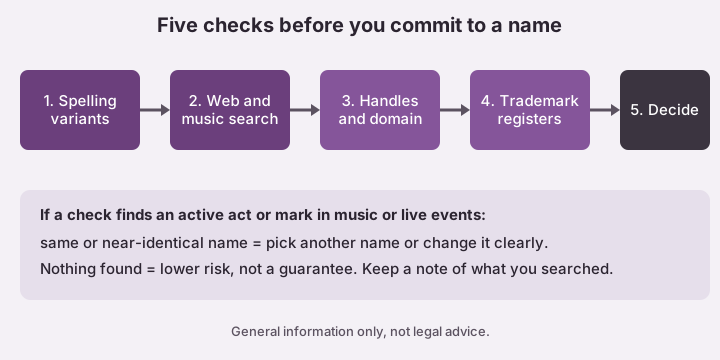
Step 1: Build your list of search strings
People rarely type a name exactly as you spell it. Before searching, write out the variants you need to test. For a made-up name like "Hollow Fern":
- With a space: Hollow Fern
- Joined: Hollowfern
- Plural: Hollow Ferns
- With an article: The Hollow Fern
- Spelling and sound-alike changes: Holo Fern, Hollow Firn
The count for the first three forms, each with and without "The", is:
Add sound-alike spellings and you may reach 8 to 10 searches. That sounds like a lot, but it takes only a few minutes, and a near-identical name can cause the same confusion as an exact one.
Step 2: Search the web and music platforms
Search each string in quotes, then again with a word like "band", "music" or "live". Look past the first page. You are looking for:
- an active band or artist with the same or a very similar name;
- a business, product, event or company in a related field (venues, festivals, labels, record shops, merchandise);
- a famous word or phrase that would drown your results.
Then search the name inside the music services your listeners use: streaming platforms, download and sales stores, video sites and ticketing or event listings. Search by artist name on each one. A band with the same name on a streaming service competes with you for the same listeners, even if it plays a different style or lives in another country.
Note the facts of each hit: genre, country, whether the act appears active, and how many releases it has. A single dormant page is a lower concern than an active act with releases and shows, but both are worth knowing about.
Step 3: Check social handles and domains
Even a name nobody has registered as a trademark can be hard to use if the handles are gone. Check:
- the handle on the social platforms you plan to use;
- a domain for the name, or a close variant if the exact one is taken;
- whether the handle or domain belongs to an active music or events presence, which matters much more than an empty parked page.
If the exact handle is taken by something unrelated, a clear variant (adding "band" or "music") may be enough. If it belongs to another act, treat that as a warning about the name itself.
Step 4: Search trademark registers
A trademark, as the US Patent and Trademark Office (USPTO) describes it on its page What is a trademark?, is any word, phrase, symbol, design or combination that identifies goods or services. The same page explains that you can gain rights simply by using a mark, but that these common law rights are limited to the geographic area where you provide the goods or services, while a registered trademark gives broader protection, including nationwide protection.
For a band, the "goods or services" are things like live music performances, recordings and merchandise. That is why you search the registers for the name, not only for other bands.
United States
The USPTO's search page is uspto.gov/trademarks/search. It names the official database as the Trademark Search system (tmsearch.uspto.gov). The USPTO page Comprehensive clearance search for similar trademarks lists these steps:
- Search federally registered and pending trademarks in the USPTO database.
- Review the Trademark Official Gazette, which publishes marks approved for registration weekly.
- Check state trademark records.
- Search the internet with multiple search engines for conflicting goods and services.
- Check domain name registrations.
- For international conflicts, the same page points to Madrid Monitor, the WIPO Global Brand Database, EUIPO and TMview.
The USPTO also explains in Why search for similar trademarks that one of the most common reasons for refusal is that the applied-for mark is too similar to an existing registered one, and that the examining attorney checks only the federal database. State and internet searches are the applicant's own responsibility.
United Kingdom
GOV.UK describes how to search existing UK trade marks at gov.uk/search-for-trademark. You can search by trade mark number, by owner, or by keyword, phrase or image.
Other countries
Most countries run their own trademark office with a free public search. Search for "trademark search" plus your country's intellectual property office, and use the official government site, not a paid third-party service that only resells the same data. This guide has not verified each country's tool, so check the instructions on the official site.
What to search for
Search the exact name, but also the sound-alike and spelling variants from Step 1. Trademark offices compare how marks look, sound and mean, and compare the goods and services they cover. The USPTO describes the key test as "likelihood of confusion": whether consumers might wrongly believe your goods or services come from someone else. This is why the same name can be fine in an unrelated field but a problem in music, entertainment or merchandise.
Is my band name taken? What the results can mean
This table gives general, practical readings of common findings. It is not a legal verdict.
| What you find | General reading | Sensible next step |
|---|---|---|
| Exact name, active band, same genre | High risk of confusion | Choose a different name. |
| Near-identical name or sound-alike, active act | Confusion is still likely | Change the name clearly, or choose another. |
| Same name, different field entirely | Lower risk, but can still affect search results | Check related goods and services; consider a variant. |
| Same name, inactive page or no releases | Unclear | Do not assume it is free; look further or choose another. |
| Trademark registered or pending for the name | The owner may object to similar use in related areas | Read the listed goods and services; consider a professional opinion. |
| Nothing found anywhere | Lower risk, not a guarantee | Record what you searched and proceed carefully. |
What if another band has the same name?
You have three realistic choices: pick another name, change yours so that it no longer looks or sounds the same, or get a professional opinion. Do not rely on being in a different town or genre as a defense. The USPTO page on trademarks says common law rights are tied to a geographic area, but your listeners reach you online, so streaming and search results do not respect borders.
When to ask a professional
The USPTO's clearance page suggests a trademark screening service or an experienced licensed attorney for a thorough search. Consider that route if you plan to register the name, sign a record or merchandise deal, or invest in branding. A short consultation costs far less than a forced rename after a release.
Quick checklist
- Write 6 to 10 search strings: spaced, joined, plural, with "The", and sound-alike spellings.
- Search web and music platforms, in quotes, with and without "band" or "music".
- Check social handles and domains.
- Search the trademark register for your country, using the official government tool.
- Write down what you found and your decision.
Once a name passes, confirm it with the whole group, as described in how to name your band. If you want more candidates in the meantime, see band name ideas by genre or generate a new batch with the band name generator.
Common questions
Is my band name taken if I find nothing in a search?
Not necessarily. Finding nothing means lower risk, not a guarantee, because searches miss unregistered or newly started acts. Search several places and keep a note of what you checked.
Do I need to register a trademark for my band name?
Registration is not required to use a name, but the USPTO says a registered trademark gives broader rights than an unregistered one. Whether to register depends on your plans and country; ask a qualified professional.
Can two bands use the same name?
It happens, but it can cause confusion and disputes, especially when both are active in music. If you find an active act with the same or a near-identical name, choosing another name is usually safer.
Which official tool should I use to search trademarks?
Use your country's own intellectual property office. For the United States that is the USPTO Trademark Search system; for the United Kingdom, the GOV.UK trade mark search. Avoid paid sites that only resell public data.
Is this guide legal advice?
No. It is general information only. For a decision that affects your income, a release or a brand, ask a qualified trademark professional in your country.