How to name your band: a practical checklist

How to name your band comes down to four moves: decide what the name has to do, collect a lot of candidates, cut them with a few fast tests, and check that the survivor is not already in use. This checklist walks through each move with a scoring example you can copy.
If you want raw material first, the band name generator gives you word combinations to react to. A reaction ("yes", "no", "almost") is easier to produce than a name from a blank page.
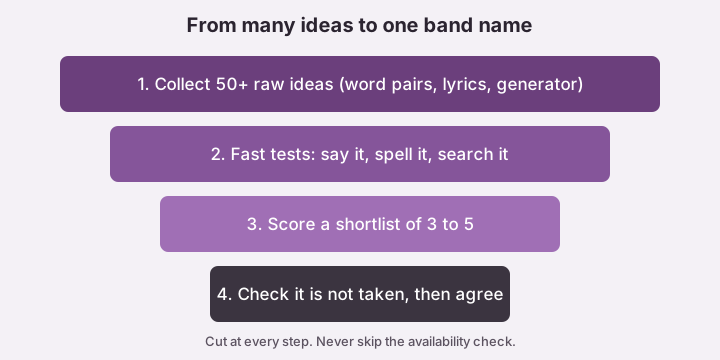
Step 1: Decide what the band name has to do
Before you collect anything, write down three things as a group:
- Sound: two or three words that describe the music (for example "loud, melodic, warm").
- Audience: who you want to find you, and where (clubs, festivals, streaming playlists).
- Limits: words you refuse to use, in-jokes that outsiders will not get, anything that would embarrass someone on a poster.
A band name does not have to explain the music. It does have to avoid fighting it. If you play quiet acoustic songs, an aggressive name sets the wrong expectation. Genre habits are covered in band name ideas by genre.
Step 2: Collect band name ideas
Quantity first, judgment later. Useful sources:
- Word pairs: one adjective plus one noun, such as "Quiet Orchard" or "Tin Harbor".
- Your own lyrics and titles: a line or an image that keeps coming back.
- Places and objects: a street, a machine, a weather word, a material.
- Invented words: a made-up word is easier to search for because nobody else is using it, but it can be harder to spell.
- A generator: use it to produce volume, then edit the results by hand.
Here is the math for a simple word-pair method. Write 12 adjectives and 12 nouns. Every adjective can pair with every noun:
At 30 seconds per name, reading all 144 takes 144 x 30 = 4,320 seconds, which is 72 minutes. Most of that time is wasted on obvious misses, so skim the list once and circle only the names that make you react. The 12 + 12 words took you a few minutes; the pairing is what a generator does instantly.
Step 3: Run the fast tests
Run every circled name through the same tests. Drop a name at the first failure.
| Test | How to run it | Pass if |
|---|---|---|
| Say it | Say "We are ___, thanks for coming" out loud, as an announcer would. | It sounds natural and nobody stumbles. |
| Spell it | Say it to a friend and ask them to type it. | They get it right the first time. |
| Search it | Search the name in quotes, then the name plus "band" or "music". | The first results are not a well-known act or product. |
| Read it small | Write it in a tiny social profile or on a ticket line. | It still reads clearly and does not run into one word. |
| Meaning check | Look up each word, including slang and other languages you may tour in. | No unwanted meaning you did not intend. |
| Fit | Imagine it on a poster for your actual music. | The name and the sound do not contradict each other. |
The "search it" test is a first pass, not a full availability check. The complete method is in is my band name taken.
Step 4: Score the shortlist
After the tests you should have three to five names left. Scoring stops the loudest voice in the room from winning by default. Give each name a score from 1 to 5 on four criteria, multiply by a weight, and add up the results.
The weights are a hypothetical choice for this example: fit and clarity count most, because they affect every poster and every conversation. Here are three invented names with invented scores:
| Name | Fit (x3) | Say-and-spell (x3) | Search (x2) | Memory (x2) | Total |
|---|---|---|---|---|---|
| Ember Parade | 4 = 12 | 5 = 15 | 2 = 4 | 4 = 8 | 39 (78%) |
| Tin Orchard | 5 = 15 | 5 = 15 | 4 = 8 | 3 = 6 | 44 (88%) |
| Low Tide Static | 3 = 9 | 4 = 12 | 3 = 6 | 4 = 8 | 35 (70%) |
Check one row: Tin Orchard = 15 + 15 + 8 + 6 = 44, and 44 / 50 = 0.88, or 88%. Tin Orchard wins because it is easy to search (a rare combination) and fits the example band's sound. A name that scores high on memory but low on search, like Ember Parade, may be catchy yet buried under other results.
Each member scores independently, then you average. If two names are within a few points, pick the one the group would be happiest to say 500 times.
Step 5: Check the name is not taken
Do this before you print anything, buy a domain, or record a release. At minimum, search the web and music platforms, check social handles and domains, and look in the trademark register for your country. The full walkthrough, including official trademark search tools, is in Is my band name taken? How to check.
Step 6: Agree and write it down
Once a name passes, get a clear yes from every member. Then write down, even in a simple shared note, who decides if the band changes the name, and what happens to the name if someone leaves. This is general information, not legal advice: if the band expects real income or a release deal, a local lawyer can tell you how name ownership works where you live.
How to name your band: common mistakes to avoid
- Falling for the first idea. Collect at least a few dozen before you decide.
- Skipping the search. A name you love is worthless if it sends listeners to someone else.
- Unusual spelling for its own sake. If people cannot type it, they cannot find you.
- Names that need explaining. An in-joke is fine only if the name also works without it.
- Letting one person decide. Scores and a group yes prevent resentment later.
Need more raw ideas? Try the band name generator again with a different mood, or read band name ideas by genre. Every idea you keep still has to pass the availability check.
Common questions
How many band name ideas should I collect before choosing?
Collect at least several dozen. A word-pair method with 12 adjectives and 12 nouns gives 144 combinations, and most will fail the fast tests, so a large starting pool leaves you a real choice.
Should a band name describe the music?
It does not have to, but it should not contradict the music. A name that suggests the wrong genre sets the wrong expectation for listeners who see it on a poster or playlist.
When should I check whether a band name is taken?
After the fast tests and before you commit money or time: before printing merch, buying a domain, or releasing music. The check takes less time than renaming later.
Is a made-up word better than two real words?
Neither is automatically better. A made-up word is easier to search for but harder to spell; two real words are easier to remember but more likely to collide with existing names.
Does this guide give legal advice?
No. It is general information. For questions about owning or protecting a name, speak to a qualified professional where you live.